Category: News

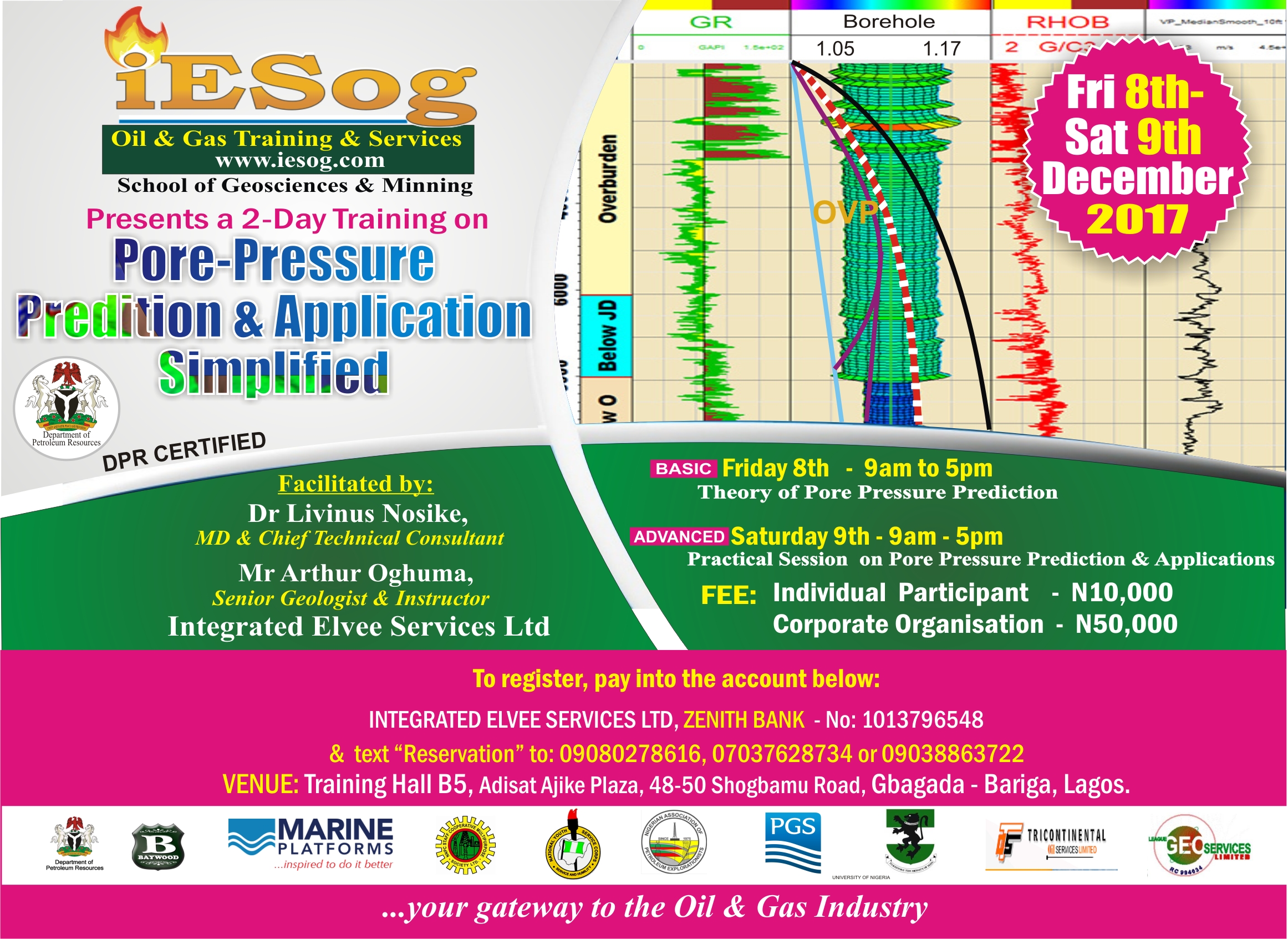
PORE-PRESSURE PREDICTION AND APPLICATIONS SIMPLIFIED 

To hold on  8th to 9th of December 2017 in Lagos. 

Part One: Pore-Pressure in Exploration

·         Pore pressure basics, Pressure Tests and WFT

·         Disequilibrium compaction, PShale and Psand

·         Dynamic transfer and hydraulic fracturing

·         Use of GR-shale points, Density and Sonic Log in PPP

·         Pore pressure and Seal Evaluation

·         Seal Integrity and Efficiency

·         Hydrocarbon Column Prediction

Part Two:  Pore- Pressure in Well Operation

·         Geopressure in Well Operations

·         From Terzaghi to Eaton’s Equation

·         S3, FIT, LOT and Fracture Gradient

·         Overburden, Bulk Density and Effective Stress

·         Practical Pore Pressure Prediction Exercise on Workstations

·         Drilling Window – Gains and Losses

·         BOP, Well Monitoring and Well control

We are making this available and opening opportunities for the average Nigerian.

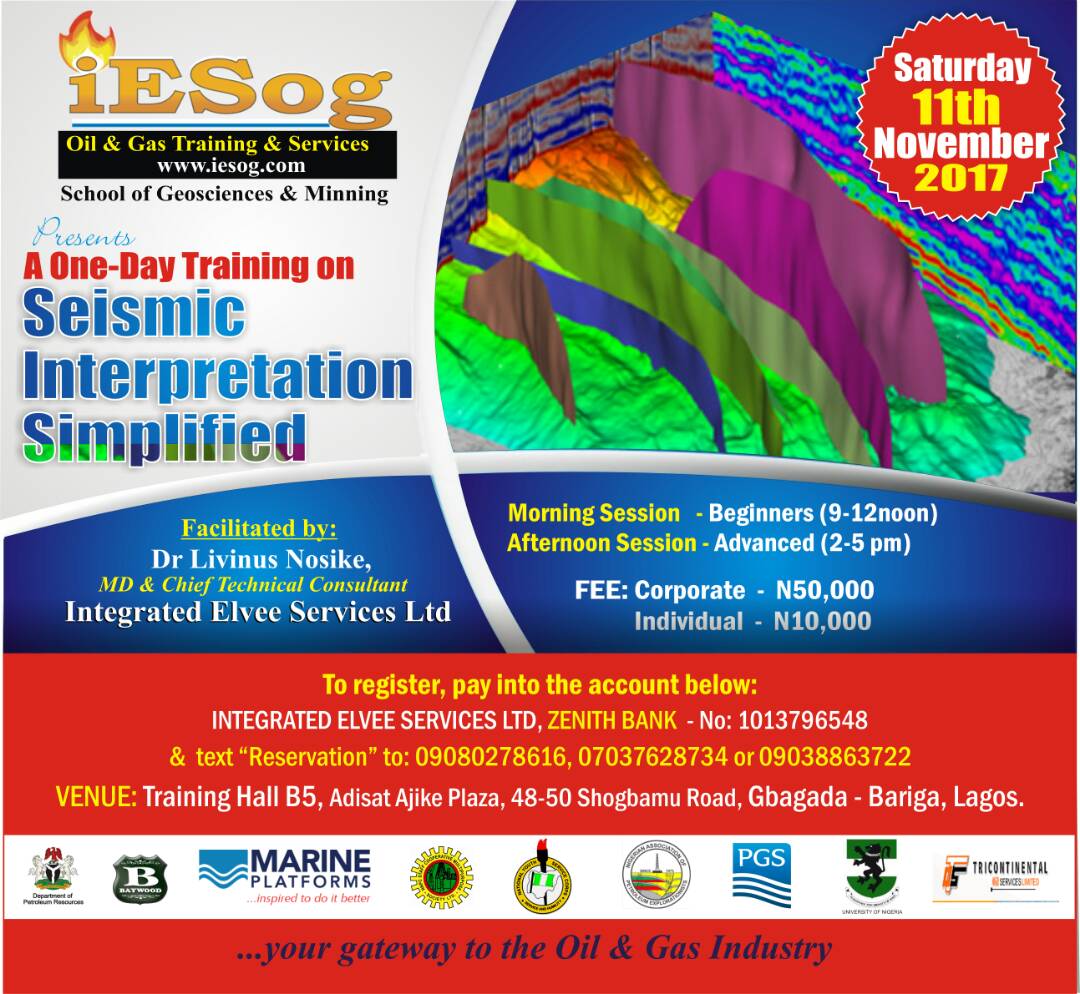
Seismic Interpretation Simplified

Aim is to give a concise quick-look method on both basics and advanced geophysical principles of seismic interpretation.

Guess what you could achieve in one day?

9-10am: Presentation on basics of seismic interp method
10-11: Inline and crossline, 2D,3D and 4D seismic practicals
11-12: Seismic interp applied to unconventional hydrocarbon

2-3pm: Introduction to advanced geophysics, DHI,AVO…fluid effect
3-4: Seismic processing, migration and Interpretation practicals
4-5: Depth to Time conversion and mistie correction

We follow up candidate and provide guide afterwards in line with our training programme. One day duration of course is strategic.

Join us at INTEGRATED ELVEE SERVICES LTD, Date: 11th November 2017, Time: 9 to 5pm

Address: Training Hall B5, Adisat Ajike Plaza, New Garage, by Baale Bus Stop. Our vehicle could pick you up once you arrive Gbagada. 

Call:  +2349080278616; +2347037628734


PERMEABILITY CHANGES WITH CHANGING DEPTHS

Weekly Petroleum Geoscience Digests

Permeability changes with changing depths – 04 September 2017

  • By Dr Livinus Nosike

If rocks cannot allow fluid to pass, then we cannot extract the oil and gas in them while drilling.  We will have to pump acid into the hole to dissolve the rock and create spaces, or we use water to push out this fluid by force.  But how do we know if the rock will or not allow fluid to flow at the depth of petroleum reservoir?  How do we compare between the permeability of muddy rock (shale) or sandy rock (sandstone)?

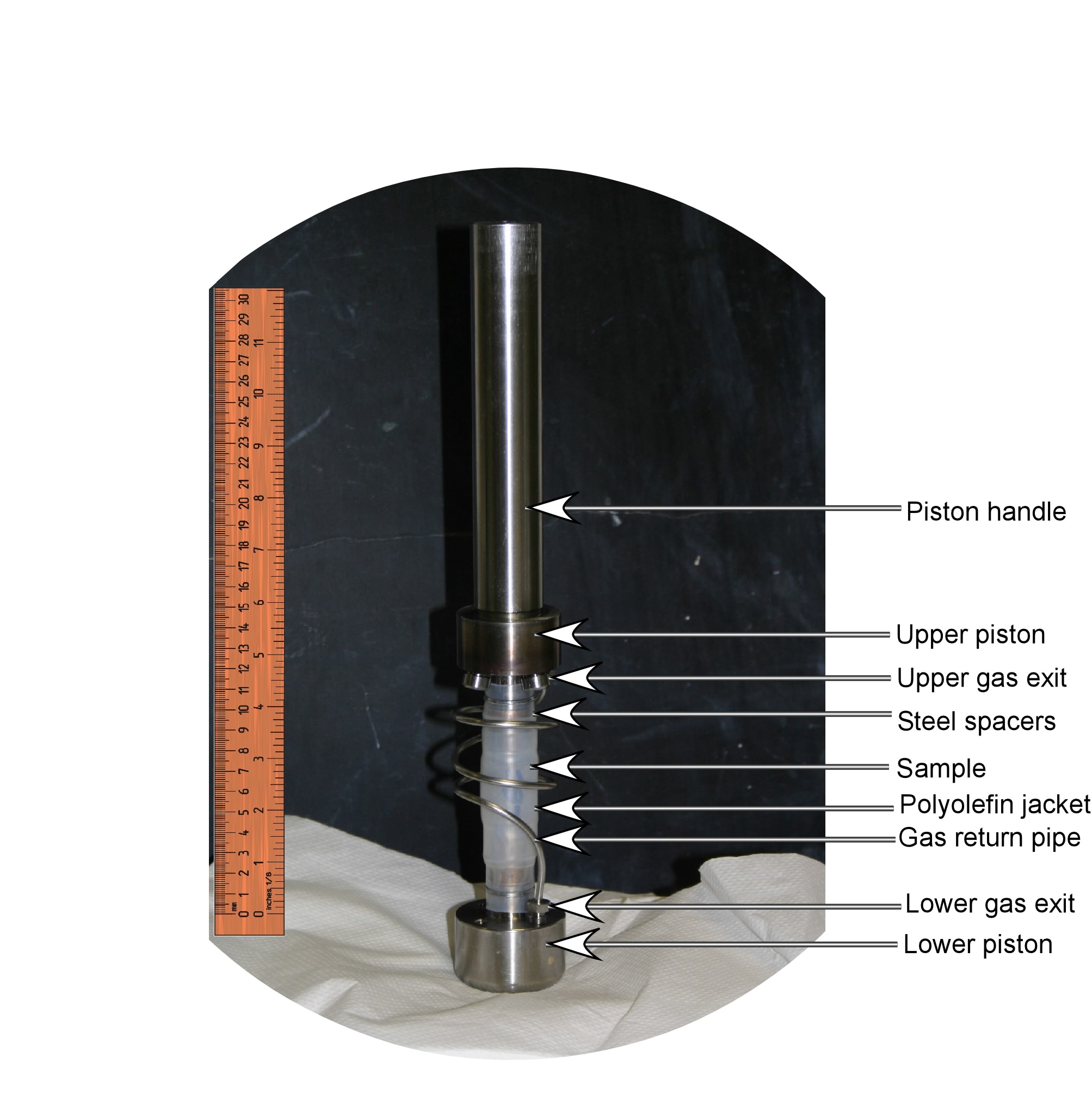
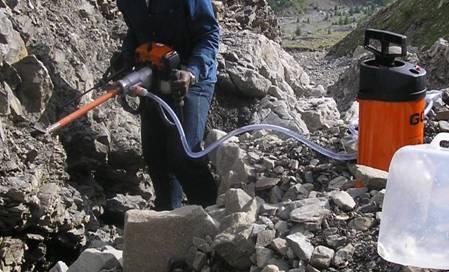
We cut out such rock on the surface by a process known as coring (see figures above). Then put the cut out sample in cellophane, waterproof, with a tube through which fluid can flow.  We then put it into a compressible container known as pressure cylinder where we can pressurize the rock sample in stages, as they would be when buried at different depths. This way we simulate permeability variation with depth (increasing pressure and temperature while measuring the permeability).

We also reduce the pressure gradually to see what happens if a rock formerly buried is lifted up or exposed by erosion where it is less under pressure/load.  At the end we are able to know how a similar oil and gas reservoir rock will behave.

From this, you see that permeability measurement requires a lot of skills and precautions.  When measuring permeability, we use a filter to block either ends of the rock sample (see diagram above), so the grains do not scatter and block the measuring tube.  We flush the valves with pressured air to ensure no particle is trapped in the tiny holes of the flow tubes.

Join me again for next week’s edition of petroleum geoscience digest or visit the news section of this website for previous editions of the digest.

For more info, contact Dr Livinus Nosike: contact@iesog.com

OIL AND GAS FLOW IN DIRECTIONS KNOWN AS ANISOTROPY

Weekly Petroleum Geoscience Digest

Oil and gas flow in directions known as anisotropy – 29 August 2017

  • By Dr Livinus Nosike

When a rock is buried, there is load above it.  Increasing soil or sediments above make it to compact and become planer.  Becoming planer means it is as if they are layers lying above each other, like several piles of sheets.  If fluid is to flow through a sheet, it will likely flow between the layers in the horizontal directions. Bending of buried rocks, known as folding or deformation, changes the original horizontal fluid flow directions.  Cracks and shifts, known as fractures and faulting of the rock layers, results in fluid choosing specific directions to flow. This preferential fluid flow direction is known as permeability anisotropy.

Permeability anisotropy is important because we care not only about the ability of fluid to flow in a rock, but also in which direction it will flow. If we know the direction petroleum fluid will flow, we put our pipe in that direction and extract it.  We also know where the fluid is coming from, where the oil and gas are generated, where more could be found.

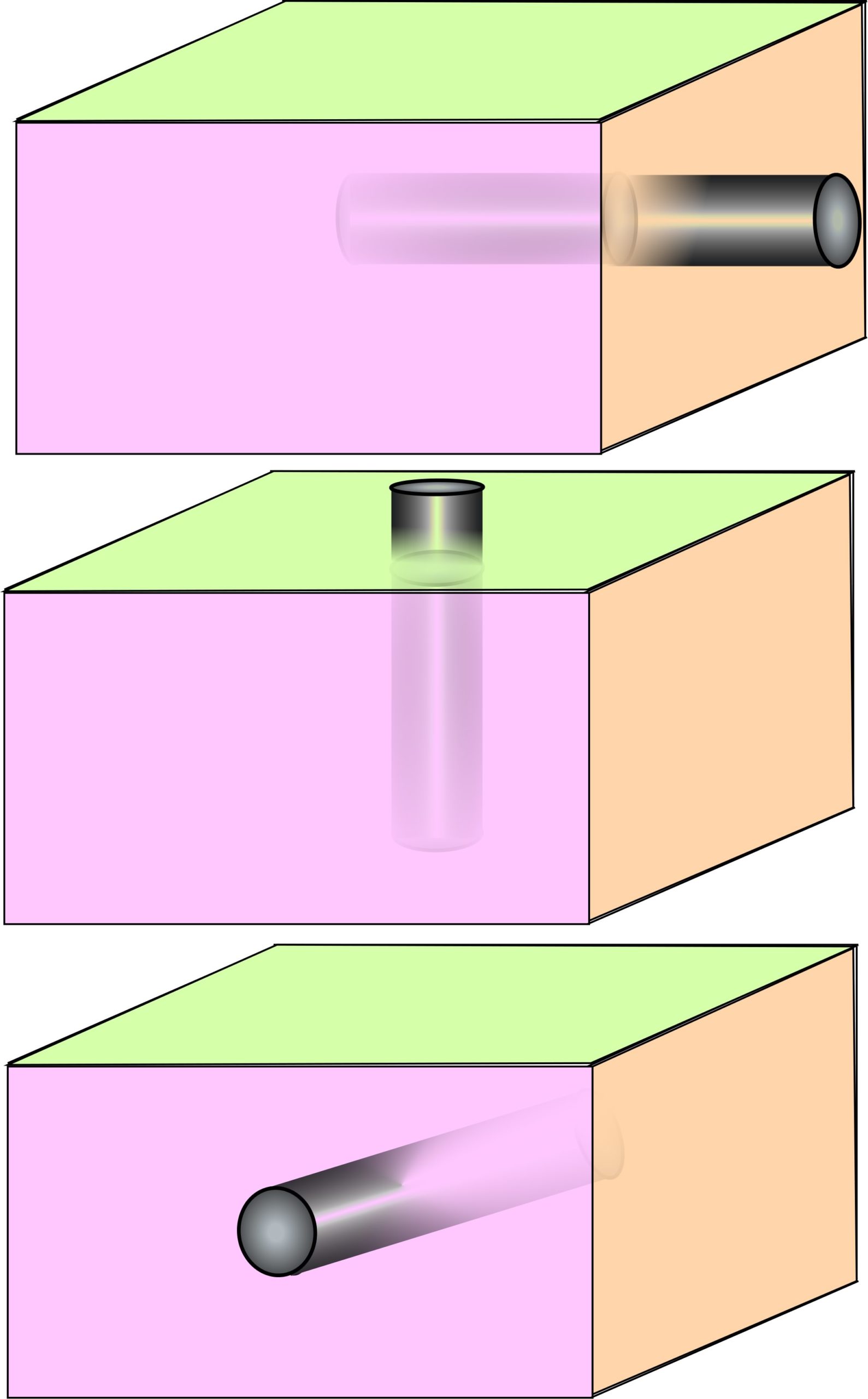
To measure permeability anisotropy, we cut out cylindrical rock sample known as plugs, in three directions: upwards, along and across the rock, as shown in the illustration above. The process of relating this small plug, small cut out rock sample, to a larger oil and gas reservoir rock is known as upscaling. Not only do you need to upscale, you need to subject the rock sample to similar condition as if it were at depth.  That is why we subject the rock sample to different pressure condition, simulating burial of reservoir rock.

This is discussed in the next episode.

Join me again for next week’s edition of petroleum geoscience digest or visit the news section of this website for previous editions of the digest.

For more info, contact Dr Livinus Nosike: contact@iesog.com

RELATIONSHIP BETWEEN ROCK SPACES KNOWN AS POROSITY AND PERMEABILITY

Weekly Petroleum Geoscience Digest

Relationship between rock spaces known as Porosity and Permeability – 22 August 2017

  • By Dr Livinus Nosike

Fluid flow through rocks because rocks have small spaces in-between their grains; these spaces are known as pores or interstitial spaces. How much of such spaces exist in a rock is known as Porosity.  Porosity is measured by adding water into a rock in a container and seeing how much of the water is absorbed. Whatever amount of water is absorbed will be equivalent to the available pores or interstitial spaces which is a measurement of the porosity.

Sometimes, we can estimate the permeability by just measuring the porosity; we provide a curve that relates one to the other. But not all spaces between rock grains are connected.  So having high porosity does not mean you will have high permeability.  Remember, Permeability is how easily a fluid like water, oil or gas passes through something like a rock.

A rock that has little or no spaces between the grains may as well have a crack, we say it is fractured.  Cracks create secondary spaces, that is, spaces that occur after the sediments or grains have come together and solidify to form the rock. The more the fractures the more fluid will flow.  Over years, certain rocks such as limestone begin to dissolves due to aging or because acidic fluid flow into them. Such dissolution also creates connected spaces and enhances permeability.

Because cracks happen in a given direction, permeability may also have direction. This relates to what we have discussed in the next episode, known as permeability anisotropy.

Join me again for next week’s edition of petroleum geoscience digest or visit the news section of this website for previous editions of the digest.

For more info, contact Dr Livinus Nosike: contact@iesog.com

PERMEABILITY AND ITS USES

Weekly Petroleum Geoscience Digest

Permeability and its Uses – 15 August 2017

  • By Dr Livinus Nosike

For the next four weeks, we will be looking at permeability.

Permeability is how easily a fluid like water, oil or gas passes through something like a rock.  So if you go outside and pour water on the soil in front of your house and the water percolates into the ground, you say the ground is permeable.  Can you think of other things that are permeable, that is, have some permeability?  Between a sand and mud, which one will have more permeability?  Which one will allow water to flow through it quicker?

We are concerned about how the oil and gas in rocks, and rock forming soil known as sediments, will allow fluid to flow in them.  This type of rock, below the ground is also known as reservoir rocks because they store oil and gas, many kilometers in the subsurface.  Because they are deeply buried under the ground, they have loads of soils and rock above them, meaning they are under pressure.  Try to use your thumb to put pressure on a straw, then try to use it to suck a drink.  It becomes difficult to do, right?  It becomes less permeable due to pressure.

Putting a rock under pressure further reduces its ability to allow fluid to pass through it because the load or pressure covers the pores or spaces between the rock grains.  It is pore spaces between the grains of rock that make it to allow water to pass through.

Places where rocks break and are shifted, known as faults are important conduits for permeability.  We cut out samples from fault zone as in the figure above, and measure them in the lab.  Can you see places on that rock that have darker and lighter shades?  The dark area is muddy (shale) while the light area is sandy (sandstone).  Sandstone is usually more permeable than shale.  This is because sandstone has more pore spaces known as porosity. Oil and gas are stored in sandstone.  Give me a sandstone with oil and gas and I will give you a petroleum well!

More information on this in the next episode.

Join me again for next week’s edition of petroleum geoscience digest or visit the news section of this website for previous editions of the digest.

For more info, contact Dr Livinus Nosike: contact@iesog.com

50% discount on all petroleum training and services registered before the end of August 2017

IES Oil & Gas announces a 50% discount on all petroleum training and services registered before the end of August 2017. This is in view of the summer regular, weekend and distance learning entry.

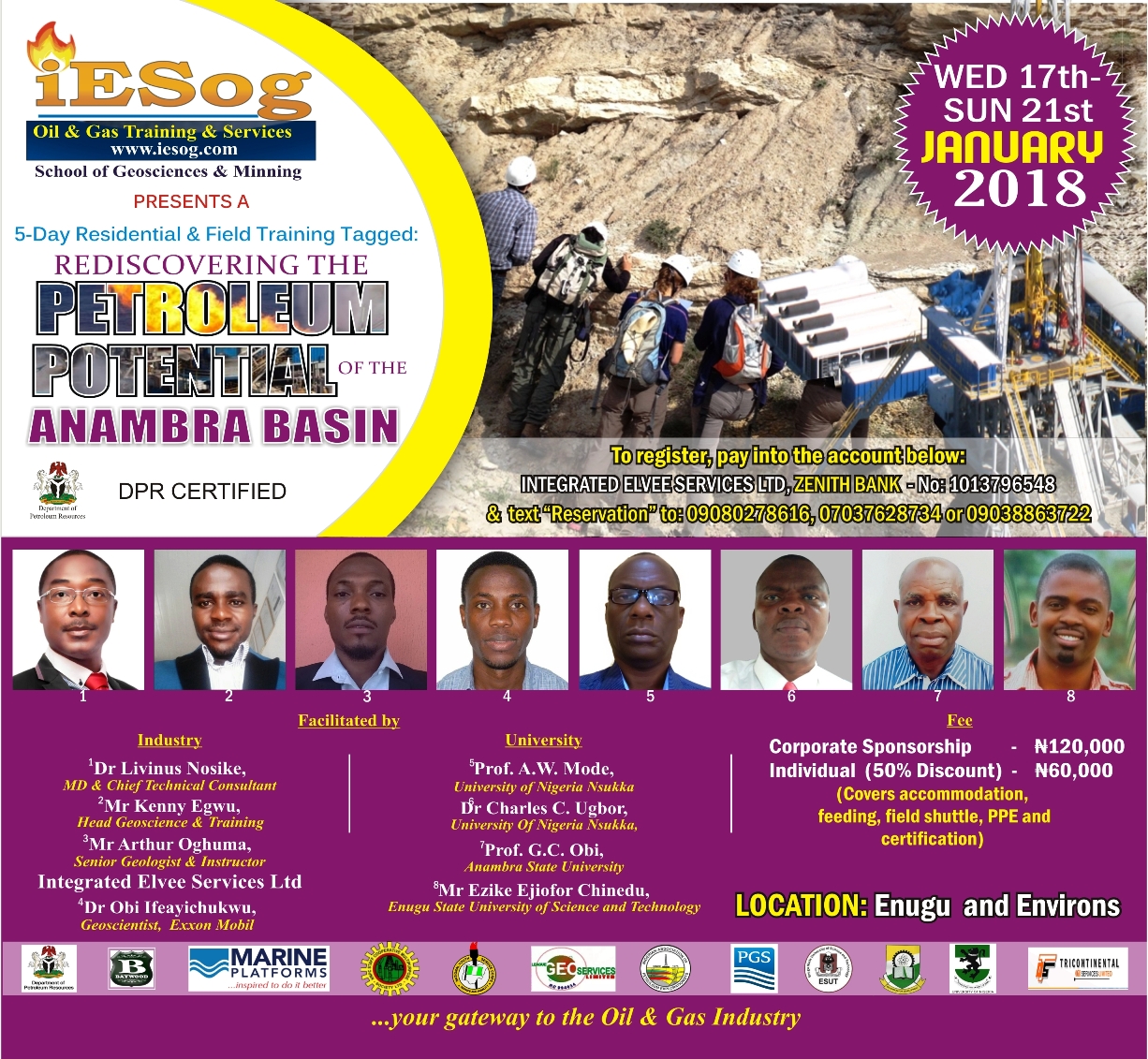
IESOG is preparing candidates for recruitment in both Lagos and Enugu States. Lagos has become an Oil State following recent discovery, while exploration for unconventional hydrocarbon is coming in Enugu.

Don’t miss this chance as training is already ongoing – see photos on
our website.

Call: 07037628734, 09080278616, 09038863722 or email: contact@iesog.com

QUANTITATIVE GEOMORPHOLOGY – Predict Earthquake

Weekly Petroleum Geoscience Digest

Quantitative Geomorphology – 01 August 2017

– by Dr Livinus Nosike

On today’s digest, I introduce to you some benefits of geomorphology.

Quantitative geomorphology is a branch of geoscience that borrows from geography in order to understand earth events and history.  It involves measuring surface features to understand what goes on under the ground.  This is important for petroleum studies and for seismological or earthquake studies.

Imagine you have a river or a valley that has been in place for millions of geologic age.  You will notice that by the sides of this river or valley, the earth is cut in what looks like a terrace.  They occur in steps of say 1m each time.   Look around you for a river or valley today.   Can you see those layers or table like surfaces, with regular thickness?  Go measure it.  You can do it!

This exists mainly in earthquake prone zones over a long time that it may be ignored.  The terrace or table are formed by major cut and shift in the earth below, known as ‘faulting’.  This major shift are results of major earthquakes. In complement with seismic sensors, they can be used to predict earthquakes in susceptible zones.

A geoscientist can estimate how long it takes to dig one meter or any consistent thickness of that terrace.   For example, if it takes 100 years to dig 1 meter each time, and the last thickness of the terrace is half a meter (dug in 50 yrs), it means it remains another 50 years for another episode of terrace to start… That is for another earthquake to occur!

This way, geoscientist can predict earthquake through quantitative geomorphology.

On the other hand, each of those terrace tables create major cut and shift below the earth surface known as faulting.  Faults are barriers to fluid flow under the ground, or passage ways.  Oil and gas fields are often faulted, cut and shifted.  The faults serve as traps or placeholders for petroleum.  So terrace and similar faults indicate oil and gas traps under the ground.  This aspect of the study is known as structural and stratigraphic geology, equivalent of applying geomorphology under the ground.

Join me again for next week’s edition of petroleum geoscience digest

For more info, contact: Dr Livinus Nosike contact@iesog.com

ANTICLINE: THE PETROLEUM GEOLOGIST’S RAINBOW!

Weekly Petroleum Geoscience Digest

ANTICLINE: THE PETROLEUM GEOLOGIST’S RAINBOW! – 8 August 2017

– By Dr Livinus Nosike

On today’s digest, I introduce to you one of the most important structure in petroleum geoscience.

An anticline is a curved layer of the earth; it is like a curved bridge made of rocks (see the above picture of an anticline).  When it curves on all sides, like an inverted pan covering what is underneath, it is called a dome.  In petroleum exploration you say it is a four-way closure. That is, it closes or covers the oil and gas lying below on all sides.  Anticline is perhaps the most important structure in oil and gas exploration and production.  That is why I call it the petroleum geologist’s rainbow.  Do you find anticlines in a sure petroleum system under the ground?  You must drill it for oil…

I still remember that first day in a field geology class, and eventually in a structural geology lesson, when that shape was drawn on the board – a simple inverted curve like a rainbow.  That day I learnt that it is even more important if it is broken and shifted, what is known as faulting, as that further traps the oil below.  I never knew this will become the most important and sought out geologic feature I will be looking for in oil and gas evaluation.  Surprisingly anticlines are not hard to find!

Have you been driving along a road and on the side you see curved earth, curved rock or sedimentary layers?  That is an anticline.  Does it look as if it is covering a sand body below?   Are the earth layer dark and the sand inside whitish?  You may be looking at a trap structure capable of holding in place oil and gas.   In a sandstone-shale sequence, common in Nigeria and most petroliferous regions of the world, the sandstone holds the oil and gas while darker layer known as shale seals the oil below. From now onward, you are an anticline hunter! I permit you to find one as soon as possible 🙂

In the picture above, my friend and I are standing just beside one, along the road, during a geological field trip. Let me know if you find one.

So why is anticline very important?

It is because oil floats above water, always rising higher until it escapes.  There is oil and water in pore spaces almost everywhere under the ground in petroleum zones.  Problem is that while the water remains and is kept in place by gravity, the oil floats and escapes. All we need is to find places where the oil overlying the water is not able to escape. Anticlines do the job, it closes the oil and gas on the sides and have them trapped on the central conical top of its structure.

For an anticline to be very useful, it has to be deeply buried under the ground. Sorry, that anticline you found on the surface along the road cannot retain the oil in it because they are cut or too close to surface where the oil is able to leak out, is able to escape.  Seismic images are used to see anticlines under the ground.  Also during geologic field trip, you can use a compass, clinometers and other tools, to detect and measure places where only a bit of the sides of the anticline, known as flank, which usually looks like bent rocks, are exposed on the surface.  They suggest, and help you to predict, that the major part of the anticline is buried deep under the ground.

That is our work as geoscientist.  Are you interested?

Join me again for next week’s edition of petroleum geoscience digest. 

For more info, contact Dr Livinus Nosike: contact@iesog.com

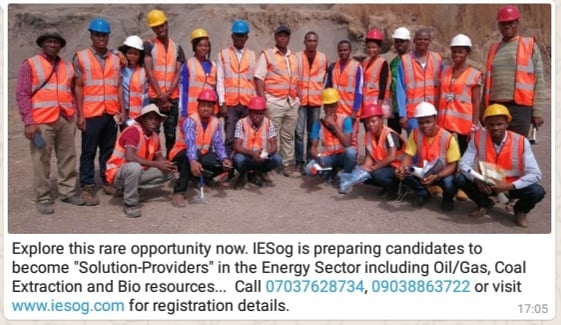
Training in Oil and Gas begins at Enugu

ENUGU YOUTHS TRAINING IN OIL AND GAS BEGINS…BRIDGING THE GAP BETWEEN COAL EXTRACTION AND OIL WELL DRILLING

  • Courtesy: INTEGRATED ELVEE SERVICES LIMITED

The first set of the targeted 180 youths to benefit from oil and gas scholarships have started training in Enugu.   This is in fulfillment of Dr Livinus Nosike’s promise to ensure that the gap between Fuel, Coal and Petroleum exploration is bridged in Enugu.  The Oil and Gas Expert, Dr Nosike, explains that many people are not aware of how far technology has gone.  He said that coal extraction in Enugu is not intended to go the old way of digging tunnels in a challenging underground terrain with its major risks.  Today coal, bitumen, lignite, has to be looked at as an unconventional hydrocarbon.

He said, “We have moved from underground to surface quarry, and now to subsurface drilling technology for unconventional hydrocarbon.  Although it will depend on the final reconnaissance and geological studies, ultimately we will opt for the drilling approach.  Drilling for unconventional hydrocarbon, including some kinds of coal beds or high organic carbon shale means you will use a rig to drill into the formation as if you were drilling for crude oil. In this case you will use hot water and acid to crack the deposit in-situ, then extract the product, which is then refined – hopefully with smaller modular refineries in place depending impending policies. This will compliment possible liquefaction where surface quarrying is adopted.

“For long the coal and other mineral resources have been ignored either because people are unaware of the new technologies or because of ease of conventional crude oil which Nigeria had in abundance. With the gas becoming more important and with the need for diversification of petroleum sources in a changing price and downing economy, it is time we look into these aspects.  This is especially now that States are beginning to look inwards for local sources of revenue.

“The State governments have challenges as well as private stake holders; with the current structure, it is only the federal government that awards license for exploration. So the State government is constrained to work with private sector to develop the resources.   Funding then has to be by investors.  Though foreign investors are currently interested in the Enugu coal revamping, wisdom behooves on interested persons, local investors, to buy into this now.  We are open to collaboration while laying the foundation with reconnaissance and exploration studies.

The youth undergoing training are made to cover modules in coal extraction as well as oil drilling.  This gap being bridged will make all the difference.  Among modules covered are:

  1. Geosciences and mining
  • Coal Extraction
  • Coal Liquefaction
  • Mineral Resources
  • Economic Geology
  1. Petroleum Geoscience
  • Onsite and Operations Geology
  • Seismic interpretation
  • Tectono-sedmentary analyses
  • Pore-pressure Prediction
  • Petroleum evaluation
  • Trap and seal analyses
  1. On-the-job Geoscience training (involving field work and full petroleum chain modules, from exploration through appraisal and development to production. Full module:   iesog.com/school

The aim is to produce holistic candidates and recruits to pioneer the industry locally.

To participate, contact Dr Livinus Nosike contact@iesog.com   Apply Online

Dr Livinus Nosike holds a PhD in Sciences of the Universe – Tectonics and Petroleum Geology, from the University of Nice-Sophia Antipolis, France, following a development of talent award to study for his postgraduate education in Europe.  He worked in technical centres in different countries, onshore and offshore, before returning to work in Nigeria. He is a Member of the Nigerian Association of Petroleum Explorationists and the American Association of Petroleum Geologists

Dr Nosike is the author of the book:  OVERVIEW OF THE OIL AND GAS INDUSTRY – A New Perspective in the Saga of the Oil and Gas Struggle. The book is now available in bookshops in every State of Nigeria www.iesog.com/bookshops

He is the Founder of IES Oil and Gas (iESog) www.iesog.com, the first fully-integrated indigenous oil and gas training and services firm with the aim of equipping every Nigerian with petroleum knowledge.


Facebook.com/DrLivinusNosike

Twitter.com/DrLivinusNosike

Instagram.com/DrLivinusNosike